

 French
 Spanish
 Russian
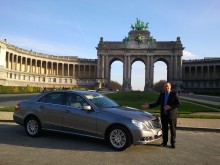
Mike - Private Guide in Brussels

Fully Licensed
Languages: English, French, German, Dutch, Italian, Spanish, Swedish
Our Private guide in Belgium is waiting for you!!!
40 years of tourism and hotel business experience.
Professional private guide in Belgium Mike is devoted to providing his guests with a memorable experience that exceeds all their expectations. Each customized tour is specifically designed to suit the specific interests and wishes of each guest, such as history, the arts, sightseeing, nature, or local gastronomy, etc.
Fully licensed private guide and driver.
I will drive you in my luxuriously comfortable Mercedes E grand luxe 2016 for up to 4 guests. We will use a pleasant van for groups of up to 8 persons.
Converse in 7 languages: English, French, German, Dutch, Italian, Spanish, Swedish.
I enjoy sharing our local legends and historical accounts. I will also assist you in any arrangements for accommodations, dining and shopping. (And I never waste time bringing my guests to " any commission shops ".)
Consistently fair rates, with no hidden or unexpected fees.
I am known for this. To welcome you to Belgium, I will be most honored to meet you at any airport or railway station (Thalys, Eurostar, etc...), and drive you to your hotel, making sure you are comfortable and your needs met as we plan your stay and the attractions you want to visit.
Private tours of this guide in Belgium
- Amsterdam guided tour
- Antwerp guided tour
- WW II - Battle of The Bulge guided tour
- Belgian Ardennes guided tour
- Bruges guided tour
- The Classical Tour
- Brussels Arts Nouveaux
- Ghent guided tour
- Luxembourg guided tour
- Normandy guided tour
- Ypresguided tour
- Waterloo guided tour
Ask private guide in Belgium
Beginning in 57 BC, Julius Caesar extended the power of Rome into the region of Europe that is now Belgium. The people he encountered there were the Belgae, one of the various Celtic tribes of early Gaul, and the Romans dubbed their new province Gallia Belgica. In the fourth century AD, with Rome in decline, control of Gaul was ceded to the Franks, a Germanic tribe that the weakened empire employed as mercenaries. As the Franks flourished, they decided to dispense with their Roman employers. By 431, they had established an independent dynasty, the Merovingian, with its capital at Tournai. Soon after, under Clovis I (c.466-511), the Merovingians succeeded in pummeling the last of the Romans in Gaul. They held large parts of present day France and Belgium as well as southwestern Germany. Clovis also adopted Christianity, thus gaining the support of the Church.
After Clovis' death the Merovingian kingdom began to fragment, and the Frankish lands did not come together under single rule again until the reign of Pepin III (the Short) in 751. Pepin deposed the last of the Merovingians and founded the Carolingian dynasty, which is named after his son Charlemagne.
On Charlemagne's death, his empire was divided, and familial feuding led finally to the Treaty of Verdun in 843. Under the terms of the treaty, three of Charlemagne's grandsons split the empire between them. West Francia, under Charles the Bold, formed the basis of France. The Middle Kingdom was given to Lothair, though it would soon fragment. East Francia, under Louis the German, became the basis of Germany. West Francia included the narrow strip of land north and west of the Scheldt river in today's Belgium. The remainder of present-day Belgium was included first in the Middle Kingdom, under Lothair, but it gradually came under the sway of the German kings.
History of Belgium, the best sights and much more - with our private guide in Belgium!
Over the next century, France emerged as the most powerful state in Europe. Under the rule of Louis XIV (1659-1715), the French made sustained efforts to extend their control over the Spanish Netherlands. Louis' ambitions were feared not only by the Spanish, but also by the Dutch, who had no desire to see powerful France extend its borders to their own. England also opposed French expansion, especially after William III, ruler of the Dutch, accepted the English throne.
History of Belgium, the best sights and much more - with our private guide in Belgium!
In the post-war period, Brussels has gradually taken on its role as the 'capital' of Europe. It is the headquarters of the European Community and the North Atlantic Treaty Organization, as well as gaining a reputation as the foremost European center of international business. In 1957, Belgium formed, with the Netherlands and Luxembourg, the Benelux Union.
Perhaps the most significant of the postwar developments has been the increasing local autonomy of various regions of the country. In 1977 the country was divided into three administrative regions: Flanders, Wallonia, and Brussels. In 1980, the Belgian constitution was changed to recognize this separation, shifting the structure of the nation to a federation. In 1995, the provinces of Flemish Brabant and Walloon Brabant were created from the old province of Brabant, leaving Belgium with a total of 10 provinces.
Our Private guide in Belgium is waiting for you!!!
OFFERED TOURS:
 €350
€350 8 hours



Latest Customer's Opinions:
Our first plan was to go to Bastogne, but the museums were closed. We opted to go to Ghent and Brugge instead. It was an excellent experience, with Mike being helpful all the way. The ride was very comfortable, not a dull moment with him. I would again hire him when I return to Brussels in the future.