


 French
 Spanish
 Russian
: Tours and Excursion
Corvin Castle
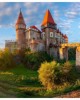
Corvin Castle, also known as Hunyadi Castle or Hunedoara Castle, is a Gothic-Renaissance castle in Hunedoara, Romania. It is one of the largest castles in Europe and a significant historical monument. The castle was built in the 15th century by John Hunyadi, a prominent Hungarian military and political leader. It served as a fortress and residence for the Hunyadi family.
History & Origins
The construction of Corvin Castle began in 1446, under the supervision of John Hunyadi. The castle was built on the site of an older fortification, which was likely a Roman camp. Over the centuries, the castle underwent several modifications and expansions, particularly during the Renaissance period. It was designed to be both a defensive structure and a luxurious residence, reflecting the power and wealth of the Hunyadi family.
During the 17th century, the castle was partially destroyed by fire and subsequently abandoned. It was later restored in the 19th century, and today it stands as one of the most impressive medieval castles in Europe. The castle has been the site of numerous historical events, including battles and sieges, and has played a significant role in the history of Transylvania.
Architecture & Features
Corvin Castle is renowned for its impressive architecture, which combines Gothic and Renaissance elements. The castle features a large courtyard, surrounded by high walls and towers. The most notable tower is the 'Neboisa' (Don't Fear) Tower, which served as a prison and torture chamber. The castle also includes a chapel, a knights' hall, and a drawbridge.
The interior of the castle is richly decorated, with frescoes, sculptures, and intricate woodwork. The knights' hall, in particular, is a masterpiece of Gothic architecture, with its high vaulted ceilings and large windows. The castle's defensive features, such as the moat and the drawbridge, are also well-preserved and add to its imposing appearance.
Legends & Facts
One of the most famous legends associated with Corvin Castle is that of the 'Well of the Turks.' According to the legend, three Turkish prisoners were promised freedom if they could dig a well deep enough to reach water. After 15 years of digging, they finally reached water, but they were not released. Instead, they were executed, and their bodies were thrown into the well.
Another legend tells of Vlad the Impaler, who was allegedly imprisoned in the castle for seven years. It is said that during his imprisonment, he developed his infamous methods of torture and execution. However, historical evidence suggests that Vlad was never actually imprisoned in Corvin Castle.
Tourist Tips
When visiting Corvin Castle, it is recommended to start with the courtyard, where you can admire the castle's impressive architecture and take in the views of the surrounding area. From there, you can explore the various towers, halls, and chambers, each of which offers a unique glimpse into the castle's history. Be sure to visit the knights' hall, which is one of the most impressive rooms in the castle.
Nearby
- Deva Fortress - A medieval fortress located on a hilltop, offering panoramic views of the surrounding area.
- Hunedoara City Museum - A museum showcasing the history and culture of Hunedoara.
- Retezat National Park - A national park known for its stunning landscapes and diverse wildlife.
- Densus Church - One of the oldest churches in Romania, known for its unique architecture.
- Sarmizegetusa Regia - The ancient capital of the Dacian Kingdom, featuring impressive ruins and historical significance.
Practical FAQ for Travelers
What are the opening hours of Corvin Castle?
Corvin Castle is open daily from 9:00 AM to 5:00 PM.
How much does it cost to visit Corvin Castle?
The entrance fee is 30 RON (approximately 6 Euro) for adults and 15 RON (approximately 3 Euro) for children.
What is the best time to visit Corvin Castle?
The best time to visit is during the spring or autumn, when the weather is mild and the crowds are smaller.
Is Corvin Castle accessible for people with disabilities?
Unfortunately, due to the castle's historical architecture, it is not fully accessible for people with disabilities.
Are pets allowed in Corvin Castle?
Pets are not allowed inside the castle, but they are welcome in the surrounding grounds.
Is there a dress code for visiting Corvin Castle?
There is no specific dress code, but comfortable walking shoes are recommended due to the uneven terrain.
Corvin Castle: Private tours and Excursions.
-
Excursion in Oradea - Corvin castle 1 day tour from Oradea with air conditioned car
We begin our trip early in the morning heading to Huneadoara town the place where the castle is located. Once there we shall buy the tickets and visit
Quick tours search
Tour Categories
- Any tour category
- Adventure tour
- Arts and Crafts tour
- Boating and Sailing tour
- Children's tour
- Culture and History tour
- Diving tour
- Eco and Wildlife tour
- Excursion
- Expedition
- Fishing tour
- Gourmet & Cooking tour
- Hiking tour
- Hunting tour
- Jeep tour
- Private tour
- Railway trip
- Safari
- Shopping tour
- Sightseeing Nature tour
- Trekking tour
- Walking tour
- Wine tasting tour
Travel Agency in Cuba

Stefano
Travel Agency in Havana
We are extremely professional! We won't simply drive you around as they will provide you all the information,tips and advices you may need during your holiday in Cuba Read more
Tour in New Zealand
Private tour in Auckland
Looking forward to have some great time on the beach? Want to discover the fruitful wine industry of the Auckland area? Well, with this private tour in Auckland you will enjoy both these great activities during a single day! Read more